
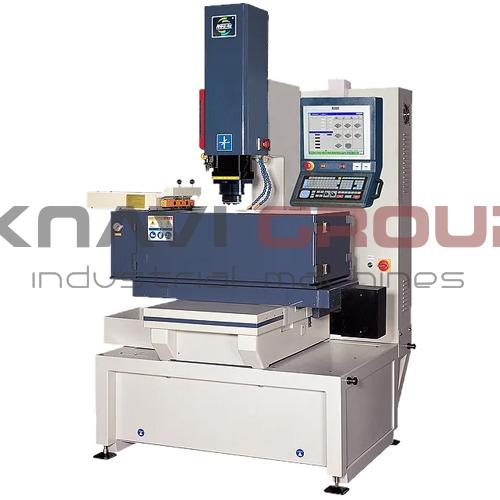
CNC Die-sink EDM machine CNC-C50E2
Price & Terms
Specifications
Machine unit
Dielectric fluid unit
Pulse generator
Accuracy
CNC
Engines and power supply
Other
Overall dimensions and weight
Equipment
Description
CNC-C50E2 Die-Sinker EDM
The CNC-C50E2 is a high-precision 4-axis electrical discharge machine with a working travel of 400×300×300 mm (X/Y/Z). It provides excellent positioning repeatability and precise erosion pulse control. It is recommended for high-precision machining of powder metallurgy parts, difficult-to-cut materials, and special materials.
The built-in AE II (Auto-Erosion) expert system automatically optimizes multi-stage EDM parameters, minimizing thermal influence (recast layer) and guaranteeing sharp corners while maintaining nominal dimensions. Stable results are achieved even on high-hardness and porous workpieces.
Key Features:
HEIDENHAIN linear scales (Germany) – 0.5 μm resolution, stable accuracy
Linear guideways and ball screws: THK (Japan), precision class, high load capacity
Work table: hand-scraped to ensure reference flatness of the contact surface
Machine bed: high-ribbed "honeycomb" structure – maximum vibration resistance and geometric stability during long-term operation
Multi-axis digital control system: Panasonic EtherCAT (high-speed protocol, short cycle times, precise axis synchronization)
Operator panel: 15" touchscreen running Windows – intuitive interface with icons and detailed tooltips for each parameter
Built-in database of >1,000 machining technologies (electrode material, workpiece material, cavity configuration)
Electrode jump speed (Z-axis): 14 m/min – effective removal of debris from the erosion zone, critical for deep cavities and holes. Performance comparable to linear motors but without the risk of spindle dropping upon power loss.
Specialized machining modes:
Carbide (hard alloys) – high speed, minimal electrode wear, Ra ≤ 0.2 μm
Graphite – high speed, low electrode wear
Large areas – uniform roughness without carbon deposits or black spots (flatness ≤ 5 μm)
Applications:
Manufacturing of molds and dies (including miniature electronic components); powder metallurgy – shaping of complex-profile parts from special materials without mechanical stress; aerospace industry – machining of superalloys and nickel-based alloys; automotive production – injection molds, dies, precision fuel system components; medical technology – implants, surgical instruments, micro-EDM; production of carbide tools (tungsten carbide).