Spring forming machines
CNC multi-former machines are available in cam and camless configurations with 4 to 12 controlled axes for producing tension, torsion, double-torsion springs and complex 3D wire forms. They are used in industrial, automotive, and instrumentation sectors to automate the production of wire components from diameters as small as 0.2 mm.
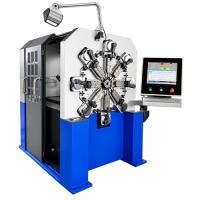
12-axis CNC spring forming machine CNC525M
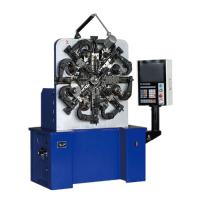
12-axis CNC spring forming machine ST65-12R
Spring Forming machine ST40-12R
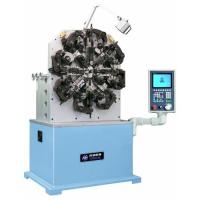
10-axis CNC spring forming machine CNC502M
3-axis CNC spring former ODM-2000
10-axis CNC spring former FP-S1008
12-axis CNC spring forming machine YF-1225
3-axis CNC spring forming machine YF-8335
CNC Spring forming machine HCT-35W
Filters
Filters
01 Brand
02 Price
03 Type of spring
04 Wire diameter — Min. diameter
05 Quantity of controlled axis
06 Voltage
07 Total motor power
08 Sliders axis
09 Wire diameter — Max. diameter
10 Spring diameter — Max. diameter
11 Quantity of controlled axis — Additional
12 Wire feed axis — Nominal power
13 Sliders axis — Nominal power
14 Wire feeding speed — Max.feeding speed
15 Core axis — Nominal power
16 Wire feed value
17 Wire feed value
Description
Spring making method known as "spring forming" is done by using the CNC spring former machines (also called universal spring machines). This type of machine is used to make tension springs, torsion springs, double torsion springs and wire forming. Spring forming machines can be used for making compression springs but is is not efficient. Spring formers have 6 to 10 tooling slides on the face of the machine enabling it to perform various bends, loops hooks,radius and various wire shapes on the ends of the springs or on the wire form itself. This type of spring making machinery is a extremely versatile.
Cam-type CNC spring former. Requires a different set of cams for making job.
Advantages:
Low price
Simple and reliable design
Disadvantages:
Requires serious machine-setting skills
Re-set of cams for each spring type
Camless-type CNC spring former. Activities are carried out through programmable motors or servo drives and controlled by CNC.
Advantages:
Fast working and easy setting
High precision
Easy to operate
Disadvantages:
High cost