
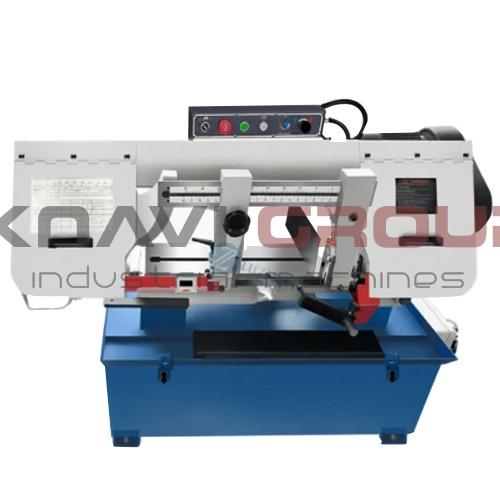
Wood cutting band saw BS-1018B
Price & Terms
Specifications
Basic feauturies
Capability
Bandsaw
Saw frame
Working table
Cutting fluid
Engines and power supply
Overall dimensions and weight
Equipment
Description
BS-1018B Band Saw Machine:
Design and Reliability
The rigid cast-iron bed ensures high vibration resistance and stability during cutting, significantly enhancing cutting accuracy and surface finish.
The reinforced saw frame is engineered for prolonged heavy-duty operation without geometric deformation.
The double-column guide system for the saw frame eliminates misalignment and guarantees a perfectly straight cut, even when processing large-cross-section workpieces.
Performance and Accuracy
The hydraulic feed of the saw frame features smooth, stepless adjustment of the descent speed, allowing operators to select the optimal cutting parameters for various grades of steel and alloys.
The adjustable blade speed (via a variable speed drive or stepped gearbox) enables cutting of both soft non-ferrous metals and hard tool steels.
Hydraulic vises provide fast and secure workpiece clamping, reducing auxiliary time and enhancing operator safety.
Machining Versatility
The swiveling saw frame (or swiveling vises) allows for miter cuts at angles from 0° to 45°, expanding processing capabilities without the need for additional equipment.
The ample jaw opening width accommodates the cutting of round pipes, structural profiles, and solid bars.
Ease of Operation and Maintenance
The integrated coolant system, complete with a pump and nozzles, reduces blade overheating, extends blade life, and improves the cut surface finish.
A chip-cleaning brush keeps the teeth clear, maintaining cutting stability and preventing blade jamming.
A blade tension indicator simplifies monitoring and ensures timely blade tensioning.
Cost-Effectiveness
Low power consumption of the main drive combined with high cutting productivity.
Minimal operating costs: band saw blades last significantly longer than circular saw blades for a comparable workload.
A narrow kerf reduces metal loss to chips, which is especially important when cutting expensive alloys.